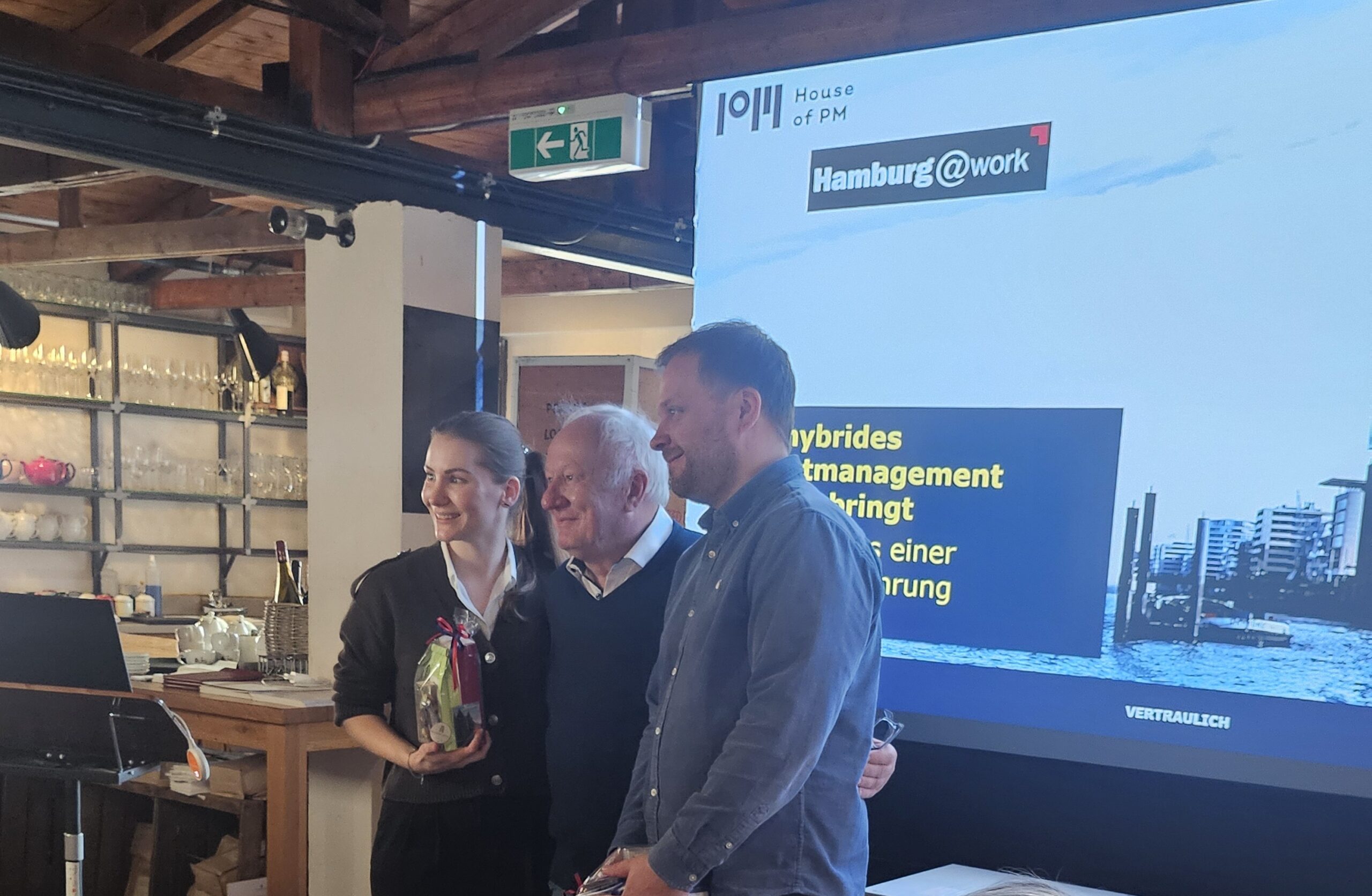
How can you manage complex projects in a structured way while remaining flexible enough to adapt to changes? This was precisely the question we addressed at the Hamburg@work Business Breakfast on April 17, 2026.
Our Perspective on Hybrid Project Management
The focus was on a real-world example from a software implementation project aimed at digitizing a process in pipeline construction documentation. It quickly became clear that neither a purely traditional nor a purely agile approach would have been sufficient to handle the complexity of the project. Only by consciously combining both approaches was it possible to effectively balance planning certainty with adaptability.
Combining structure and flexibility in a meaningful way
The presentation demonstrated how a hybrid approach can work in practice: with clear project phases and mandatory milestones on the one hand, and iterative implementation, close feedback, and continuous adaptation on the other. The project utilized a Water Scrum Fall approach, which incorporated requirements, design, implementation, testing, and deployment into a robust structure while leaving room for development and learning.
Tailored to project needs
The benefits became particularly evident where many hybrid projects ultimately succeed: in the collaboration between different stakeholders. Departmental teams tended to work in a more traditional manner, while external software development followed the Scrum methodology. The hybrid project approach served as a bridge between these two worlds. This was precisely the key to success: not simply juxtaposing different methods, but tailoring them specifically to the project’s needs.
Clear goals and requirements
At the same time, the presentation also showed that hybrid project management is not a sure thing. The need for communication is increasing, training is becoming more important, and leadership is changing. Differing levels of knowledge, new tools, and unfamiliar forms of collaboration initially increase complexity. This is precisely why clear goals and requirements, strong communication, flexibility in implementation, and a commitment to continuous improvement are essential.
Our conclusion
Our conclusion from this morning was clear: hybrid project management delivers real value where projects do not fit into either rigid planning or pure agility. It enhances adaptability, improves risk management, increases efficiency, supports customer focus, and fosters teamwork. The key is not to follow a specific method, but to design the approach in a way that truly serves the project.
>> Contact
Would you like to discuss this topic with us?
Take advantage of our offer for a non-binding and free initial consultation with our experts. A direct and simple way to find out whether our view and approach is of interest to you.